Showing posts with label Trackers. Show all posts

Monday, 29 June 2015

Old Audio Part 2: Some Lesser Home Computers

The previous article, 'Part1: You People Don't Know You're Even Born' is available here.

A frustrated beginning

If only I'd learned to program properly when I was younger. I started pretty young, with my first professional game work happening when I'd just turned 16, but if I could have actually programmed the playroutine as well as writing the music I wouldn't have had to contend with the myriad of software and systems by different programmers and companies. I could have worked more quickly and probably earned more money until CD-Audio became the standard. It would have made my job at Psygnosis easier early on if I could have just spent a few weeks writing a player for whichever platform I had to use. It happened to some extent, but I wasn't yet a good enough programmer to do more complex stuff.

In 1990, when I had just turned 16, I got a phone call asking me if I wanted to do the music on Last Ninja 2 on the Amiga. Now then, when I read other pieces about how other people got started in whatever they do, there's always very important stuff missing. Like when you read interviews with someone and they casually drop in "...and then I was signed by Sony". Woh there! Hold on a minute! How exactly did that happen? Telepathy? Did a Sony A&R walk past you in the street, smell that you could write music and then immediately pop a contract from his suit pocket? I always want to know how it got to that point. So for what happened in my case, you'll have to read Part 3, but for now, continue on...

It Begins

So...In 1990, when I had just turned 16, I got a phone call asking me if I wanted to do the music on Last Ninja 2 on the Amiga. Obviously I did want to because I'm not insane and thanks to the timing, the half-term holiday was coming up at school. For the week of that holiday, I went to the office of Consult Software in Birkenhead, sat there with a tape recording of the C64 music and converted it to the Amiga with Noisetracker. I got £40 per tune, which is the equivalent of around £90 today. They got a bargain, but 7 tunes equalled an amount of money I'd never comprehended owning before. It was brilliant. I splashed out on a joystick just because I had the money. I've still got it and it still works like new. :)
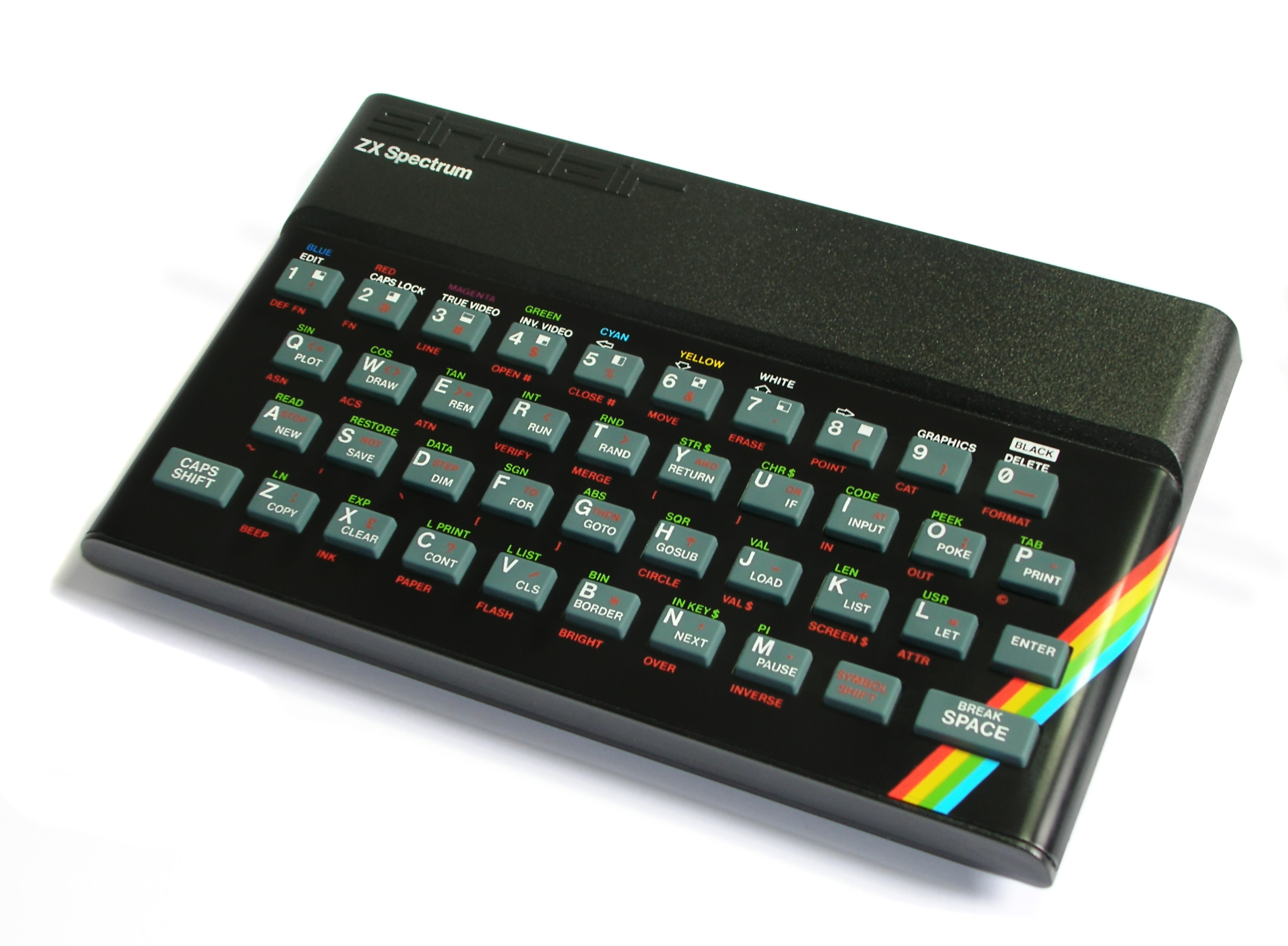

The original ZX SpectrumAnyway, more on the Amiga later. While I was there, Consult Software were also doing some other game conversions and it was on one of them that I got to do my only ZX Spectrum (known as the Timex Sinclair in the USA) music, for Donald's Alphabet Chase. Going from the interface that I can remember, and doing a search, I'm pretty sure that the software I used was "Wham! The Music Box". it was taglined 'The Complete Sound System For Your Spectrum', but I think they must have got confused about the meaning of the word "complete".Wham! The Music Box editing screen It had two notes of polyphony, which was actualy mildly impressive for the spectrum when it was released in 1985. Notes had to be entered into a stave, but it was basically a step-time sequencer (like a horizontal Tracker) because every note was a quaver. If you wanted longer notes, you just put multiple consecutive quavers of the same note. With it I made an absolutely shocking version of the Alphabet Song in about 15 minutes. I also did a rubbish Amiga version and the Amiga sound effects as well, which led me onto doing...

You've got an ST? State!

Atari ST imageThe Atari ST was £100 cheaper than the Amiga because it was £100 less impressive. The soundchip was the AY-3-8910, an utterly dreadful excuse for a synthesizer with three square waves and a noise channel. It's a shame really because the ST was supposed to have the AMY chip, which would have had 8 channels with additive synthesis (but no sample playback), but it got cut for cost and timing reasons. I wasn't thrilled with the idea of doing Atari ST music but it was only music for the title screen. There was a music package for the ST called Quartet, which allowed playback of 4 sample channels, basically giving it the same capability as the Amiga at the expense of almost the entire CPU. As I'd already done the Amiga version of the game, I just ported it to Quartet using its not-a-tracker notation-based interface. Compared to using a tracker, it was a bit slow going and took about a day to do, but it ended up sounding identical and therefore exactly as poor as the Amiga version.

Bad as the ST was for sound, Atari made the bizarre decision to add MIDI ports, which gave it a life in music far beyond what would be expected. Cubase and Logic originated on the Atari ST and it garnered a large following for general music production.

And that was pretty much my entire output for anything that wasn't an Amiga in the 8 and 16-bit transitional era. You might notice that luckily enough, tools were available for what I needed to do. Sadly, I never got to do any music for my beloved Commodore 64. Because I couldn't yet program. Because I had clearly not yet learned how to stop being an idiot.

Still to come: Psygnosis stuff, Amiga, The FM Towns, SNES, a failed Megadrive attempt, Playstation, PC, N64, beepy mobile phones.

Next Up: Part 3: Amiga, career-maker

Friday, 26 June 2015

Old Audio Part 1: You People Don't Even Know You're Born

Chiptunes have quite a following these days. But why?

Is it really that great to have Gameboy music playing through massive speakers? A lot of people seem to think so, even though it's mostly just square/pulse waves. Yet, Roland would be laughed at if they released a synth that only had three square waves and a noise channel, so what's the big deal with it?

The square wave genre, including AY chips and the other doorbell sound chips, certainly has its charm. It sounds pretty unique compared to any other style of music and the limited capabilities definitely forge creativity (giving us some great melodies), but my word it can sound like an absolute travesty without a skilled person at the helm. A true assault of sonic knives stabbing at the ear drum, and make no mistake it was the same back in the day. There was an abundance of absolutely appalling music on every game platform.

But the good stuff can be very good indeed. Who doesn't love Chipzel? She's brilliant. And hilarious. It's understandable that people would want to emulate her and other's success, but there are so many people trying to make Gameboy music right now that it's borderline ridiculous. Chiptunes are 'in' right now and the barrier to entry is unbelievably low, almost as low as picking up a guitar and strumming E, A, and D. It's very easy now to download a Gameboy emulator, load LSDJ into it, and start making music thinking that you're just like game composers of yore.

But things were not so easy back then. Even after somehow getting hold of the dev kit, it could be a complete pain to do any audio on the machines of old and it was a constant battle against the restrictions of the hardware. It was not a particularly pleasant situation and all we ever wanted was for those restrictions to go away. I find it somewhat amusing that people now celebrate what was a mostly awful restricting environment, but the power of nostalgia (for things real or romanticised) can be very strong indeed.

In this series of articles I shall describe the sometimes crazy processes I've had to go through to create music/sound on various game platforms, beginning of course with the Gameboy.

If only now had been then

How can you hate MIDI, Mr. Clarke? You must be an idiot!

I don't hate MIDI for writing music in general, but when dealing with low-spec devices, MIDI is one of the worst possible formats. It's fine for trying to recreate a jazz band on a synthesizer, but appalling for fine control of a sound chip. The direct control over the sound that you get from a Tracker is a world apart from the fuzziness of MIDI.

MIDI has no concept of audio channels or polyphony. Either a player would have to restrict itself to one MIDI channel per sound channel or you'd have to be very careful when placing notes so that there are no notes overlapping. If there were, the second note could spill your lead sound into the next sound channel and cut out a bass note.

Instrument changes are incredibly laborious in MIDI. It takes ages to do clever effects like switching samples very quickly on each note. The nature of how MIDI is purely a song data format meant that designing instruments for your music was a completely separate process from writing the music. In a limited capability environment having immediate and direct control over the sounds while editing the music data is really important.

Doing pitch and volume effects in MIDI is really cumbersome. You have to set the pitch bend limits in the instrument and then insert hundreds of pitch bend values into the MIDI data. With a tracker you could just repeat a command at each note step and it would continually perform that command. You can do nice effects with this like repeating a pitch command with a high value while retriggering the sound at different notes, or repeating a decrease volume command while resetting the volume each step to get a staccato effect. Dynamic portamento was also very easy to do with this method and very controllable.

How about the bubbly-sounding fast arpeggiations that chip tunes are known for? Most trackers have this as an arpeggiation command where you specify the relative note numbers to cycle through, but with MIDI you'd have to enter each individual arpeggiation note by hand. Why do those arpeggiations sound so characteristically like old game music? Because the rate at which the notes changes is the refesh rate of the TV, i.e. 50 or 60 times per second. If you go faster or slower than that, it starts to sound different.

Basically, if you want your music to sound good on a weak chip, you have to do clever stuff that is really awkward to do in MIDI. Step-based players like trackers or custom playroutines were always designed to take advantage of the nature of the chip itself and made it much easier to implement that effects that could make it all sound good.

I will touch more on MIDI when I get to PCs and mobile phone audio in a later article.
Most of my music was on the Amiga using Protracker, which is really the basis for all of these modern chiptune trackers (although it could be argued that Protracker and its originator The Ultimate Soundtracker were based on earlier programs like Soundmonitor on the C64, which itself was based on earlier hand-coded music players and works in a very similar way to the Real-Time Composer interface of the Fairlight CMI sampling workstation). In a way, I had it easy because I could use a tracker while others before me had no choice but to use self-written code. On other platforms, I was not so lucky.

There were few public tools available for computers and none at all for consoles (as you needed to get a licence and a devkit from the hardware manufacturer). Most tools and players were written in-house at whichever game company was writing whichever game. These tools would never see the light of day outside that company. To even get tools in the first place could be problematic. They would obviously have to be written by a programmer who hopefully understood something about audio, and that would take time and money. It was a big investment for a company and programmers interested in audio were very hard to come by, so it would be pretty common that a programmer would shovel together the bare minimum and leave the musician to just get on with it. This could be anything from just a music player with the music data having to be written directly in hexadecimal in a text editor to more user-friendly toolsets with instrument editors and so on.

Never again, please

I only ever worked on one Gameboy game. It was called Force 21 and was originally a PC realtime strategy game from Red Storm Entertainment. The port was by The Code Monkeys and they had their own Gameboy audio player that they had used on previous games. Worst case scenario, I thought, was a bunch of assembler code into which I would write music data, which is how I mostly worked on the SNES and my own players. But no. It was worse than that. It was a MIDI player. I always hated MIDI.

It got worse.

To get the music into the correct format, I had to use their MIDI converter, which was written for the Atari ST.

It got even worse.

Their MIDI converter wouldn't convert the MIDI files that I output from Bars & Pipes on the Amiga. As it turned out, it would only convert MIDI files that were exported from a specific version of Cubase.

And yes, it was even worse than that.

After getting the music into the correct format, I then had to email the data file to the programmers who would package it up in their music player and send me back a Gameboy ROM file of the player with the music embedded to check if it worked okay.

The original music that I had to convert was a set of really nicely done orchestral music by David Frederick. I had to convert that into 1 square wave, 2 pulse waves and white noise. Not easy to do without it sounding like crap, but I usually enjoyed trying to get the most out of limited capabilities. It was a pain though, converting orchestral stuff was definitely the hardest thing to have to do.

To do it, I made a Gameboy emulation with my K2000 (possibly the finest synthesizer ever made). It was just a simple setup that matched the setup of the instruments on the Gameboy, with one sound on each MIDI channel. Then I wrote the music in Bars & Pipes on the Amiga that was connected up to the K2000 (as was my other gear), like with all of my music. Once that was done, it went through an utterly ludicrous process to be ready for the game...

Here's the complete sequence of events:
  1. Convert the music from the MP3s of the original orchestral score to fit the limitations of the 4 channel Gameboy.
  2. Export a MIDI file from Bars & Pipes.
  3. Copy that MIDI file from my Amiga to the PC via a floppy disk.
  4. Load the MIDI file into Cubase.
  5. Export a MIDI file from Cubase, having performed no operations on the original.
  6. Put the MIDI file into a specific folder.
  7. Load the Atari ST emulator and run the conversion program inside it.
  8. Load the MIDI file into the conversion program.
  9. Save out the data file.
  10. Email the data file to the programmers.
  11. Wait.
  12. Receive the ROM file from the programmers.  One time, it was 3 days until I got the ROM file back.
  13. Load it into the No$GB emulator.
  14. Listen to the new track and make sure everything sounded as expected.
The experience was so insane that after I'd finished, I spent the next three weeks writing my own Gameboy music driver in z80 assembler. It had plugin synthesis modules and sample playback, but it never got used for anything. I stopped being freelance and moved to London to do full-time audio programming. I enjoyed creating it though. There's something cathartic about going through an opcode list and realising that you can save two clock cycles if you replace that clear command with a multiply by zero instead. If I can ever find it, I'll post the source code here.

Force 21 PC music
Force 21 Gameboy music 

Next: Part2: Some Lesser Home Computers